
Tax guide
The Tax guide has three tabs: What you can claim, What you can’t claim and Jargon, translated. The articles What you can claim, What you can't claim and Words you'll see in Bilbee carry their full text.
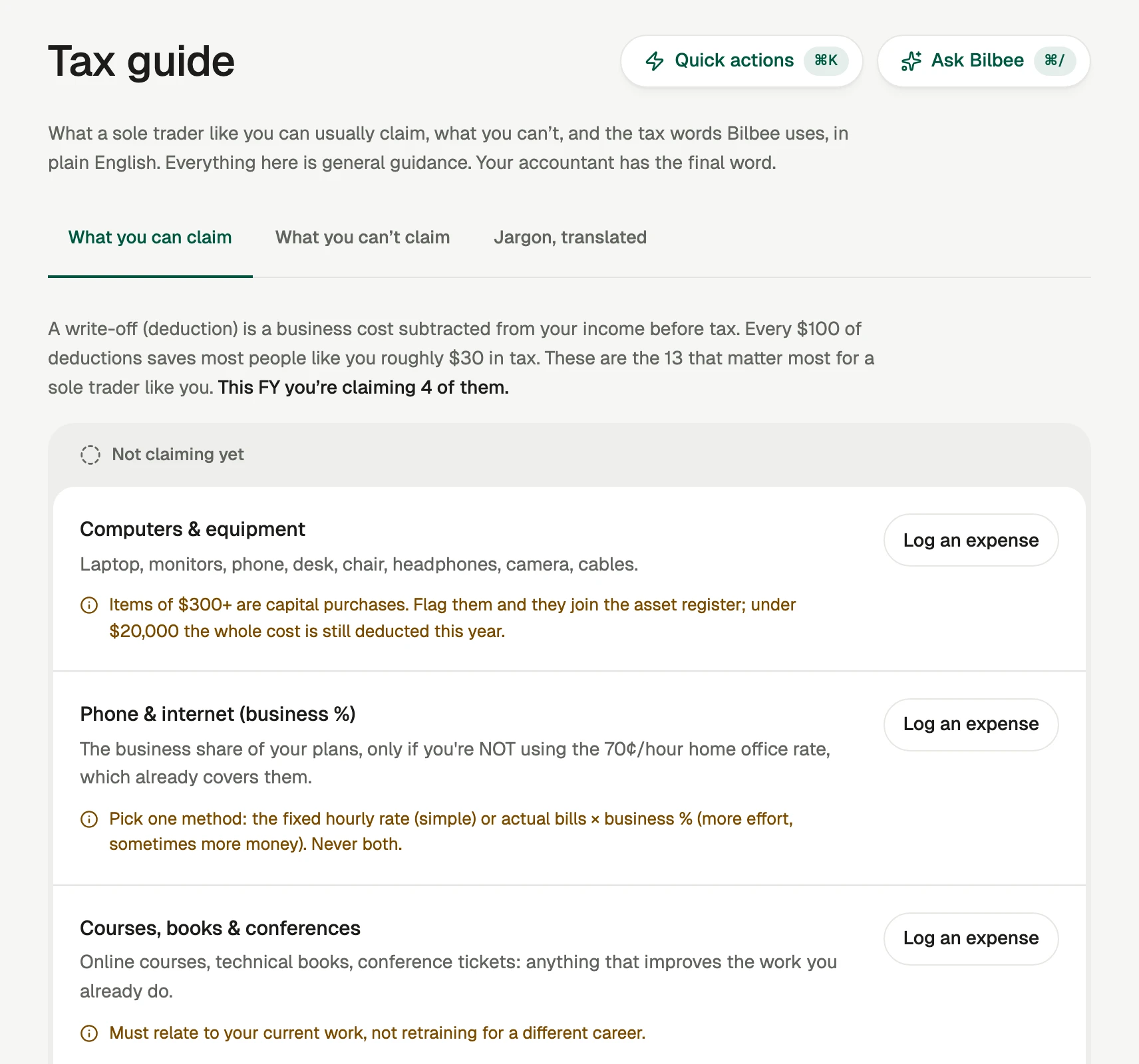
What a sole trader can and can't claim, and the words you'll see in Bilbee.
The Tax guide has three tabs: What you can claim, What you can’t claim and Jargon, translated. The articles What you can claim, What you can't claim and Words you'll see in Bilbee carry their full text.
The Tax guide's What you can claim tab lists the deductions most sole traders have, split into Not claiming yet and Already claiming from your own records this financial year. Each one links to where you record it.
Software & subscriptions: Adobe, Figma, GitHub, hosting, domains, stock assets, AI tools, fonts. If you use it for work, it's deductible. On the guide: Log an expense.
Computers & equipment: Laptop, monitors, phone, desk, chair, headphones, camera, cables. Items of $300+ are capital purchases. Flag them and they join the asset register; under $20,000 the whole cost is still deducted this year. On the guide: Log an expense.
Working from home (70¢/hour): One rate covers your electricity, gas, internet, phone usage and stationery for every hour you work from home. Hours must be logged as you go. The ATO rejects year-end guesses. And don't also claim phone/internet separately; the rate already includes them. On the guide: Log hours.
Phone & internet (business %): The business share of your plans, only if you're NOT using the 70¢/hour home office rate, which already covers them. Pick one method: the fixed hourly rate (simple) or actual bills × business % (more effort, sometimes more money). Never both. On the guide: Log an expense.
Courses, books & conferences: Online courses, technical books, conference tickets: anything that improves the work you already do. Must relate to your current work, not retraining for a different career. On the guide: Log an expense.
Accounting & legal: Your accountant's fees (including BAS and tax return preparation) plus any legal advice for the business. On the guide: Log an expense.
Business insurance: Professional indemnity and public liability premiums. On the guide: Log an expense.
Car trips for work (88¢/km): Driving to client sites, suppliers, the post office or the accountant. Log the km, claim 88¢ each, up to 5,000 km/year. Normal home-to-workplace commuting doesn't count. And the rate already covers fuel, rego, insurance and servicing. Log km OR those bills, never both. On the guide: Log a trip.
Website & marketing: Your portfolio site, hosting, advertising, business cards. On the guide: Log an expense.
Work travel: Flights, hotels, taxis and parking for work trips. Keep a travel diary for trips of 6+ nights; personal add-on days aren't claimable. On the guide: Log an expense.
Bank & payment fees: Account fees, transaction fees, Stripe/PayPal merchant fees. Deductible, but GST-free. There's no GST credit in them. On the guide: Log an expense.
Super contributions: Money you put into your own super is deductible up to the $30,000 cap, often the single biggest deduction available to a sole trader. It must reach the fund before 30 June, and you must lodge a notice of intent with the fund before claiming. On the guide: Record a contribution.
Subcontractors: Anyone you pay to help deliver client work. On the guide: Log an expense.
This is general guidance for a sole trader, not tax advice. It's worth checking anything about your own return with your accountant.
The Tax guide's What you can’t claim tab lists the common myths:
Everyday clothes, even if you only wear them for work (no uniform, no claim)
Commuting between home and a regular workplace
Coffees, lunches and client entertainment: almost never deductible. Log them under Meals & entertainment and Bilbee keeps them out of your deductions and your BAS
Fines and penalties (parking, speeding): log them under Fines & penalties, kept out the same way
Gym, haircuts, glasses: private even if work benefits. Paid from the business account? Log it under Private / not deductible so your bank statement still reconciles
The private share of anything mixed-use: that's what business use % is for
This is general guidance for a sole trader, not tax advice. It's worth checking anything about your own return with your accountant.
The Tax guide's Jargon, translated tab explains each term. In the app, a dotted underline under a word shows its meaning when you hover over it.
GST: Goods and Services Tax: 10% added to most things sold in Australia. You collect it on your invoices for the ATO; it was never your money.
BAS: Business Activity Statement: the small form you send the ATO each quarter saying how much GST you collected and paid. This app pre-fills the three numbers.
G1 · Total sales: Everything clients actually paid you this quarter, including the GST portion.
1A · GST on sales: The GST included in what clients paid you. You owe this to the ATO.
1B · GST on purchases: The GST inside your business expenses. The ATO gives this back by knocking it off what you owe.
cash basis: Counting money when it actually moves: you owe GST when the client pays you, not when you send the invoice.
financial year: Australia's tax year runs 1 July to 30 June, not January to December. “FY25–26” means July 2025 through June 2026.
PAYG instalments: Pay As You Go: once you owe enough tax, the ATO asks you to prepay it quarterly instead of one scary bill. Instalments are credits, not extra tax: they come off your final bill.
deduction: A business cost the ATO lets you subtract from your income before tax is calculated. A $100 deduction doesn't save you $100. It saves you $100 × your tax rate (roughly $30).
instant write-off: Normally big equipment is deducted slowly over years (depreciation). Under the $20,000 instant write-off, a sole trader deducts the whole cost in the year of purchase instead.
capital purchase: Something you buy that lasts years (a laptop, a desk, a camera), as opposed to something used up, like software subscriptions. Capital items go on the asset register.
business use %: If something is partly personal (your phone, your internet), you only claim the business share. Be honest and pick a defensible percentage.
GST credit: The GST inside a business purchase that the ATO refunds you via your BAS. Over $82.50 you must hold a receipt (tax invoice) to claim it.
tax invoice: A receipt that shows the seller's ABN and the GST amount. The ATO requires one for purchases over $82.50. A photo is fine.
concessional cap: The yearly limit (currently $30,000) on super contributions taxed at the cheap 15% rate. Personal contributions you deduct count toward it.
notice of intent: A short form (s290-170) you send your super fund saying “I intend to claim this contribution as a deduction.” No notice and acknowledgement, no deduction.
Medicare levy: An extra 2% of taxable income that funds Medicare, paid on top of income tax by almost everyone.
small business offset: A discount for sole traders: 16% off the tax on your business income, capped at $1,000 a year. The ATO applies it automatically.
HELP/HECS repayment: A compulsory student-loan repayment added to your tax bill once income passes the threshold (~$67k from 2025–26). It's charged only on the income above the threshold, so it stacks on top of your income tax. Worth setting aside for.
taxable income: What's left after every deduction comes off your income. It's the number tax brackets actually apply to. Lower taxable income = less tax.
standard deduction: From 2026–27, up to $1,000 off your taxable income if you earn salary or wages, with no receipts needed. The ATO applies it for you. Business income doesn't count towards it.
set aside: Money you park in savings for the ATO as you earn it (the GST you collected plus a slice for income tax), so BAS and tax bills are already covered.
reconcile: Matching each bank transaction to what it was (an invoice being paid, a business expense, or something personal), so nothing is missed at tax time.
ex GST: The price excluding GST. “inc GST” includes it. Deductions are claimed ex GST when you're GST-registered, because the GST part already came back via your BAS.
Add your business details, send an invoice, record an expense. The estimate does the rest.
Start freeFree to start: five invoices a month, no card.